Published Aug 28, 2026. Updated Sept 1, 2026.
Corian® Solid Surface wall panels give architects an unusual combination: a surface that can perform in demanding commercial environments while behaving more like a design medium than conventional cladding. The material is nonporous, can be joined with inconspicuous seams, and can be carved, thermoformed, illuminated, repaired, and renewed. Those qualities make it relevant anywhere a wall needs to be easy to maintain without looking merely utilitarian.
For healthcare environments, high-traffic corridors, elevator lobbies, hospitality spaces, wet areas, and exterior facades, the question is not simply whether a panel looks good on installation day. Designers also need to consider what happens after years of cleaning, carts, luggage, fingerprints, weather, and occasional damage. This is where Corian can offer a different lifecycle proposition from tile, stone, painted drywall, laminate, or cast concrete panels.
Why Architects Specify Corian Wall Panels
Nonporous and grout-free
Renewable and repairable
CNC-carvable
Thermoformable
Translucent and backlightable
Class A fire-rated
Supports infection control when properly maintaned
Available for engineered interior and exterior systems

Large scale feature wall at American Airlines in LAX. Custom sand dune design. Los Angeles, CA.
What Are Corian Wall Panels?
Corian is a solid, homogeneous surfacing material made from acrylic polymer and mineral filler. Unlike a printed laminate or coated panel, its color and composition continue through the material. Sheets can be cut and finished with precision, bonded into larger assemblies, or fabricated into dimensional architectural surfaces.
In wall applications, Corian may be used as smooth protective cladding, a carved commercial feature wall, a curved transition, a translucent illuminated surface, a wet-area surround, or part of an engineered exterior rainscreen. MR Walls develops both curated Spec Ready and Studio Custom designs, allowing teams to begin with an established pattern or develop geometry around a specific building, brand, or design concept.
Why Corian Performs in Healthcare and High-Traffic Spaces
A nonporous, grout-free surface
Many wall finishes introduce recurring joints, grout lines, surface coatings, or porous materials that demand additional maintenance. Corian itself is nonporous, and large panels reduce the number of joints across a wall. When properly fabricated and installed, the result is a continuous-looking surface without the grid of grout associated with tile.
That matters in spaces where cleaning is frequent and where edges, corners, and joints can become collection points for dirt. Corian should not be described as a substitute for a facility's infection-control program, but its smooth, nonporous surface can support straightforward cleaning protocols. When properly cleaned, Corian does not enable the growth of mold and mildew.

Close up of fulti-colored branded wall displaying backlighting and invisible seams. MNGI ASC & Clinic.
Designed for contact, circulation, and repair
Hospital corridors, airport concourses, university buildings, hotel lobbies, and elevator areas experience constant contact. Painted surfaces can scuff; laminates may chip or delaminate at an edge; stone can crack or stain; and a damaged modular panel may need to be replaced. Corian is renewable: many scratches and marks can be removed through cleaning, abrasion, or refinishing by an experienced fabricator. Because the material is homogeneous, refinishing does not expose a differently colored substrate beneath the surface.
The wall assembly, pattern depth, finish, and location still matter. A deeply carved tactile surface will be cleaned differently from a smooth panel, and any high-impact zone should be detailed for the actual traffic it will receive. MR Walls can adapt panelization and surface treatment for hallways, elevator lobbies, grand entries, and other high-use applications.
Continuous-looking, visibly joint-free
Large walls still need to be fabricated, transported, and installed in manageable sections. Corian's advantage is that hard seams can be bonded with color-matched joint adhesive and finished so they become inconspicuous within the overall composition. Flexible movement joints and some corners may instead require color-coordinated silicone. Panel layout, substrate preparation, temperature movement, pattern placement, and installer skill all affect the result.
MR Walls' interlocking panel approach is designed to align large, non-repeating compositions while reducing obvious visual interruptions. The goal is to engineer the assembly so the viewer reads one continuous architectural surface.

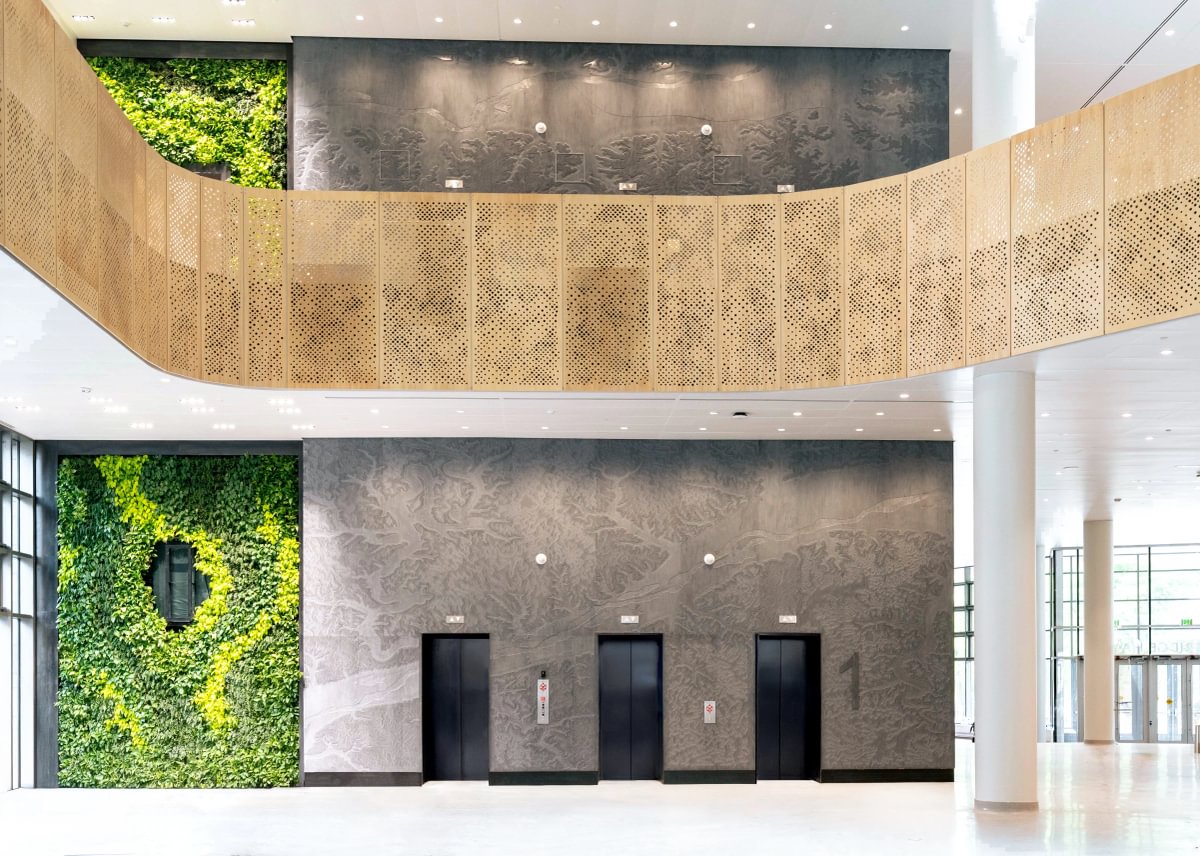
Panel diagram of an elevator lobby and final installation with invisible seams. Santa Clara Valley Medical Center, CA.
What Corian Allows Designers to Do
Carve pattern and depth into the surface
CNC machining can translate digital artwork, natural forms, graphics, topography, or brand language into the material itself. Instead of applying decoration onto a wall, the wall becomes the design. MR Walls can scale a pattern across a large surface without forcing it into an obvious repeating tile, whether the client selects a pre-developed Spec Ready design or commissions a Studio Custom composition.
Thermoform curves and transitions
When heated under controlled conditions, Corian sheets can be formed into three-dimensional shapes. This makes it possible to carry a wall around a corner, soften a transition, wrap a column, or respond to compound architectural geometry. At the Jefferson Health Honickman Center, Stantec and Ennead Architects brought along MR Walls to carve and thermoform Corian panels so a cloud-inspired texture could continue through smooth corners across 17 floors.

Hallway curves into the elevator lobby with a seamless Cloud design. Jefferson Health, PA.
Transmit shape and light
Colors like Glacier White Corian can transmit diffused light, and selective carving changes how much illumination passes through different areas. This allows the material itself to glow rather than acting only as a screen in front of a light source. Backlighting can be combined with smooth faces, carved relief, curves, graphics, or RGB programmable systems. The complete assembly must coordinate panel thickness, lighting distance, diffusion, electrical access, and heat management. Explore the MR Walls Backlight System or the detailed article on backlit Corian wall panels for commercial interiors.

Marylin Monroe feature wall with backlights on and off.
Where Corian Wall Panels Have an Advantage
No material is universally better than another. The right choice depends on design intent, budget, loads, fire and code requirements, maintenance expectations, fabrication access, and the complete wall assembly. The useful comparison is therefore not 'Which material wins?' but 'Which material best resolves this project's priorities?'
Interior Applications: From Clinical Corridors to Wet Areas
In healthcare, Corian wall panels can combine a cleanable surface with a calmer, more tactile architectural experience. At Jefferson Health, the material supports both goals: the cloud texture creates visual continuity and a high-touch sensory element, while the nonporous wall surface is suited to a demanding care environment. Similar principles can apply to public waiting areas, imaging centers, patient-room features, elevator lobbies, and long corridors.
In hospitality, education, workplace, aviation, and multifamily projects, the priorities may shift toward identity, durability, and scale. A carved wall can establish a recognizable arrival moment without relying on applied graphics. In commercial showers and wet areas, large grout-free panels can simplify the visual field and reduce the number of joints that need routine attention. Every wet-area assembly still requires appropriate waterproofing, substrate preparation, perimeter seals, penetrations, and installation details.

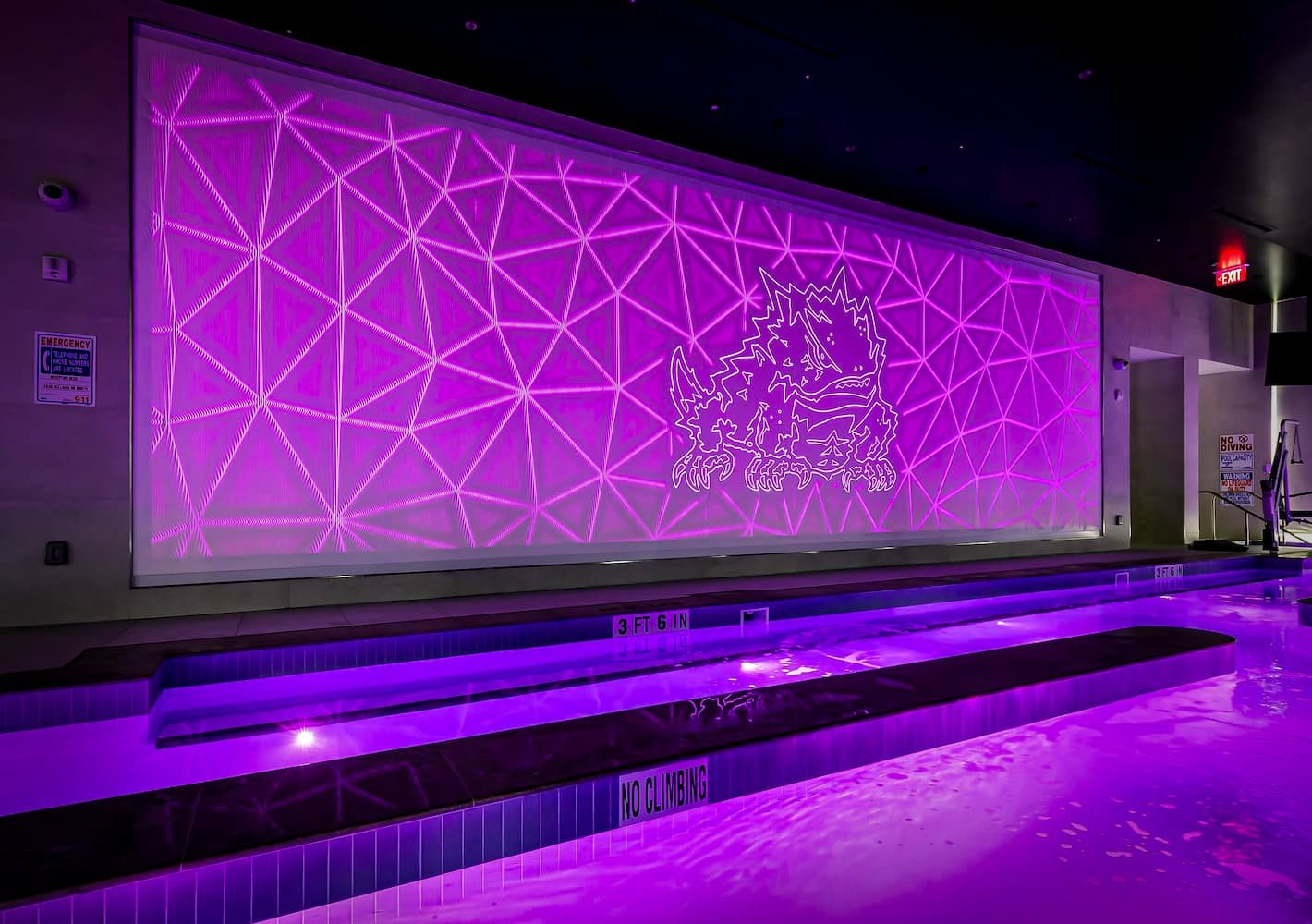
Branded backlit wall by the pool. Design: Origami + Horned Frog logo. TCU Simpson Family Restoration Center, Fort Worth, TX.
Exterior Corian Panels: Material and Rainscreen Must Work Together
Corian can also be used in engineered exterior cladding systems. Suitable exterior colors offer low moisture absorption, weather resistance, through-body color, and the possibility of cleaning or refinishing surface damage. Panels can be cut, carved, perforated, layered, or thermoformed to create architectural forms that would be difficult to produce in stone or conventional sheet materials.
An exterior facade is never only a panel. Wind loads, thermal movement, attachment type, drainage, ventilation, fire performance, panel thickness, substructure, access, and local code requirements must be resolved as a coordinated system. MR Walls' facade and exterior work includes concealed rear anchors, cleated systems, face fixing with matching plugs, and overlapping assemblies selected according to the project.
At The Lindley's Columbia Street, a custom, multi-story facade art feature gives the entry a distinctive civic-scale identity. A digitally composed relief is distributed across five stacked zones, creating a continuous visual field while coordinating with floor-by-floor movement, panel fabrication, and the supporting wall assembly.

Exterior relief panel wall art, five levels high. Design: Nazare carved on overlapping fins. The Lindley - CA
Case Study: Reengineering a GFRC Concept in Corian
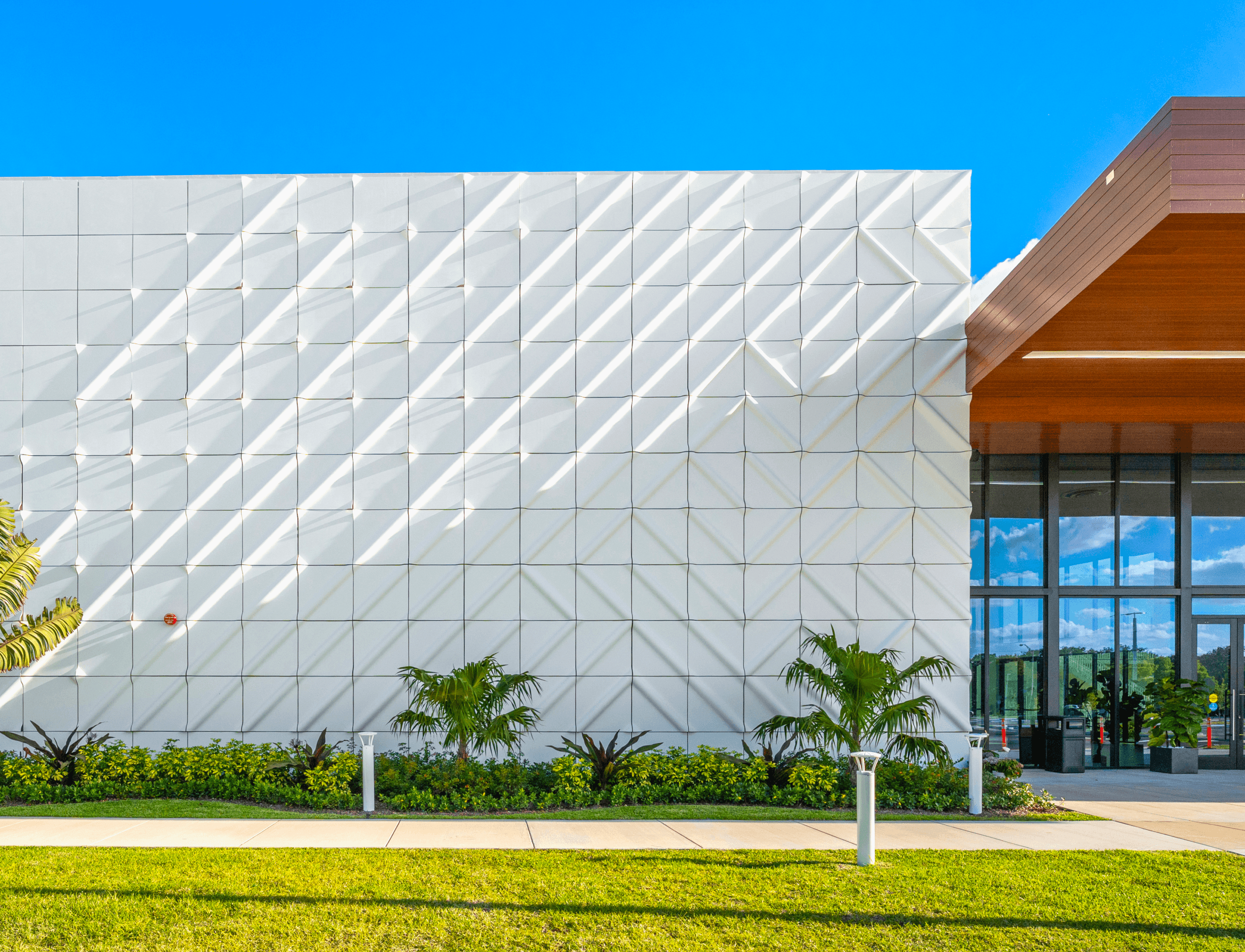
Christ Journey Church in South Florida began with a sculptural facade concept designed in glass-fiber-reinforced concrete. According to the project team, the proposed GFRC approach would have introduced more weight, expense, and a porous exterior surface. MR Walls reengineered the design in thermoformed Corian while preserving the intended geometry.
The completed solution uses approximately 1,000 square feet of custom formed Corian panels and was engineered for hurricane wind conditions up to 180 mph. The lighter, nonporous panels allowed the white sculptural form to remain crisp while reducing the structural and maintenance concerns associated with the original approach.
This does not mean Corian will replace GFRC on every facade. GFRC remains a strong choice when the design calls for authentic concrete character, repeated cast forms, or a noncombustible assembly. The lesson from Christ Journey Church is more specific: when a project requires lightweight sculptural geometry, a refined continuous-looking finish, and renewable surface performance, Corian can change the cost and constructability equation.

Custom thermoformed facade with geometrical design. Christ Journey Church, FL.
Questions to Resolve Before Specifying Corian Wall Panels
Is the application interior, wet-area, exterior, or a transition between conditions?
Does the project need a smooth protective surface, a carved design, a curved form, backlighting, or a combination?
Which Corian colors, thicknesses, finishes, and fabrication methods are appropriate for the environment?
How will panel sizes respond to transport, site access, substrate tolerances, pattern continuity, and replacement access?
Where are hard seams appropriate, and where are flexible movement joints required?
What cleaning agents, maintenance practices, impact loads, fire criteria, and code requirements apply?
Who is responsible for substrate, structure, waterproofing, lighting, electrical work, attachment engineering, installation, and final inspection?
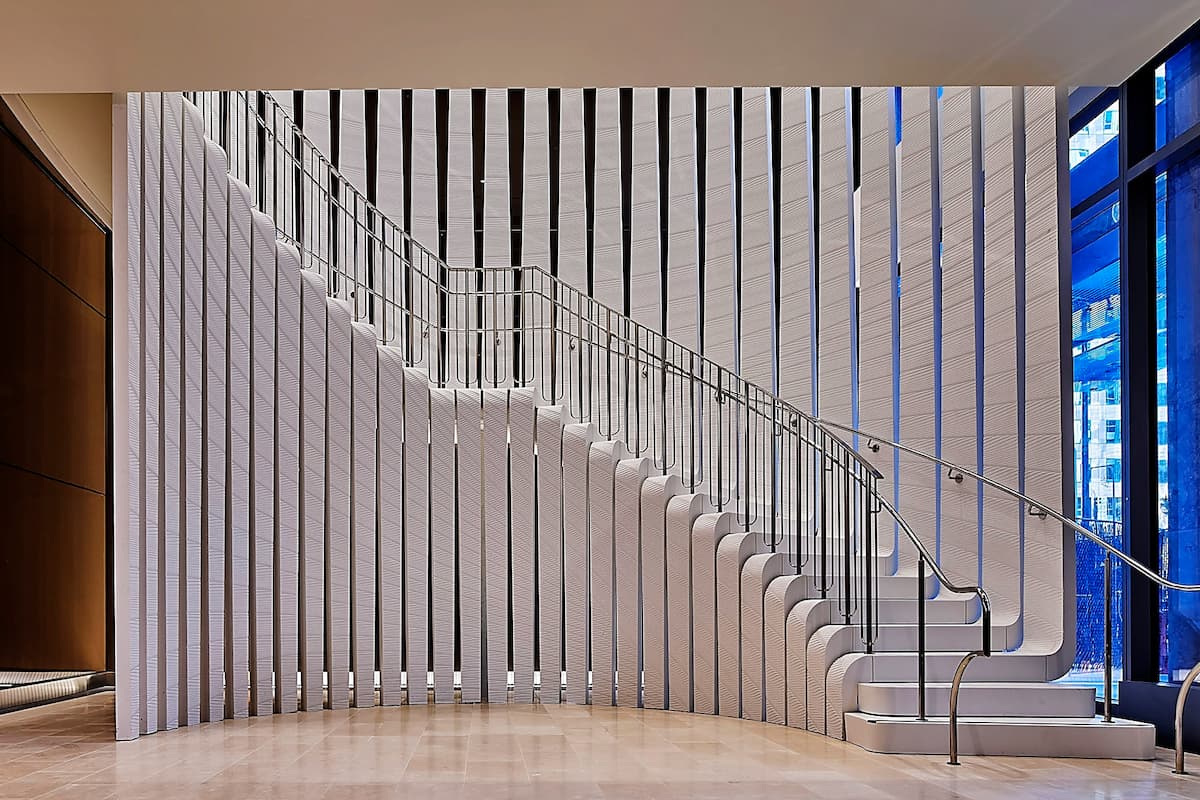
Early coordination is especially valuable when the design includes complex geometry. MR Walls' DuPont Corian partnership and design-assist process connect pattern development, fabrication, panelization, shop drawings, and installation planning before those decisions become expensive to change. For another example of geometry being translated into a practical assembly, see the 8th & Figueroa staircase case study.
Frequently Asked Questions
Are Corian wall panels seamless?
They can achieve a virtually seamless or continuous-looking appearance, and hard seams can be bonded with color-matched joint adhesive and finished to become inconspicuous. Some spots may require color-coordinated silicone.
Are Corian wall panels suitable for hospitals?
Corian is widely used in healthcare because it is nonporous, cleanable, repairable, and capable of reducing grout lines and crevices. Suitability depends on the complete assembly, cleaning protocol, finish, detailing, and applicable facility requirements. It can support infection control if properly maintanted.
Can Corian wall panels be used outside?
Yes, when an exterior-suitable color and an engineered facade system are specified. Wind, thermal movement, drainage, ventilation, attachment, fire performance, substructure, and local requirements must all be evaluated for the project.
How does Corian compare with marble or natural stone?
Corian is lighter, nonporous, thermoformable, renewable, and capable of more inconspicuous joining. Marble and stone offer genuine natural variation and material character that Corian does not attempt to duplicate. The better choice depends on whether the project prioritizes natural provenance or fabricated continuity, form, cleanability, and repairability.
How does Corian compare with GFRC?
Corian can be lighter, nonporous, thermoformable, through-colored, and renewable. GFRC offers real concrete character, efficient mold repetition, and advantages in noncombustible assemblies. For sculptural facades, teams should compare not only material price but also molds, support structure, handling, finish maintenance, panel replacement, and installation time.
Discuss Your Corian Wall Project
A Corian wall can begin with a performance requirement, a sketch, an established pattern, or a complex architectural form that has not yet been resolved. MR Walls can help determine whether a Spec Ready or Studio Custom approach is appropriate and coordinate material, pattern, panelization, fabrication, samples, shop drawings, and installation strategy.
Explore the MR Walls design library, review more Corian design possibilities, or share your project dimensions, application, location, timeline, and design intent with the MR Walls team. Early input can identify the right system before material, structure, and geometry are developed separately.